Borrowers choose you for the relationship.
They leave because of what's behind it.
A borrower picks a community bank or credit union over a fintech or a big bank because of the relationship: a loan officer who knows the market, a name they trust, a branch they can walk into. What loses that borrower isn't the relationship. It's a borrower acquisition system and technology stack that's often a decade or more behind the biggest competitors, sitting one click behind the relationship the borrower actually wanted.
A Mortgage Signal Report pinpoints the public signals that show how healthy that acquisition system is, built entirely from what's already public: your rate page, your application path, your fraud indicators, your loan officer contact flow. No backend access. No internal data request. No sales call before you see what we found.
Delivered in 3 business days, or your money back.
What's costing funded volume is the system sitting behind the relationship.
A community bank or credit union in the $1B–$10B range doesn't lose mortgage volume because the relationship is weak. It's usually the opposite. The rate is competitive. The underwriting is sound. The loan officers know the market better than any national lender ever will.
What's costing funded volume is the system sitting behind that relationship: the acquisition path a borrower has to move through before the relationship even gets a chance to matter. For most institutions this size, that system and the technology running it haven't been rebuilt in a decade or more, while the biggest competitors have rebuilt theirs two or three times since.
Three patterns show up over and over in Texas community banks and credit unions this size:
None of this shows up in a core banking report. It shows up on the page, and it's costing funded volume every day it goes unmeasured.
No amount of traffic fixes a broken path.
Smaller financial institutions tend to track the wrong numbers. Site visitors. Social media posts. Whether a piece of content "went viral." Those are the metrics a marketing team reports on, and they're the wrong ones for a lending pipeline, because none of them measure whether a borrower moved from inquiry to funded loan.
In our research across 112 financial institutions in Texas, this pattern held consistently: institutions chasing visibility metrics while the conversion metrics, the ones that actually predict funded volume, went unmeasured entirely.
This is why marketing can't close the gap. The problem isn't a lack of content or reach. It's a system problem: the acquisition path itself is broken or missing at specific points, and no amount of traffic fixes a broken path. Closing a system gap takes a system designer, not a marketing plan.
Every signal rated against your specific digital presence, on the date we looked.
Not an industry average. Not a template scored against a national bank five times your size.
Scorecard
Every applicable signal in the Borrower Friction Index, rated red, yellow, green, or grey against your actual mortgage page, application path, and fraud indicators.
Lead findings
The two to four gaps costing your pipeline the most, named specifically and tied to where they sit in the funnel: rate transparency, application friction, or loan officer visibility.
What's working
The signals already functioning, named specifically. A credible report says what's right before it says what's wrong.
Every report closes with one next step. Not a proposal. Not a service menu. One conversation, to find out whether what we found from the outside matches what your team already suspects from the inside.
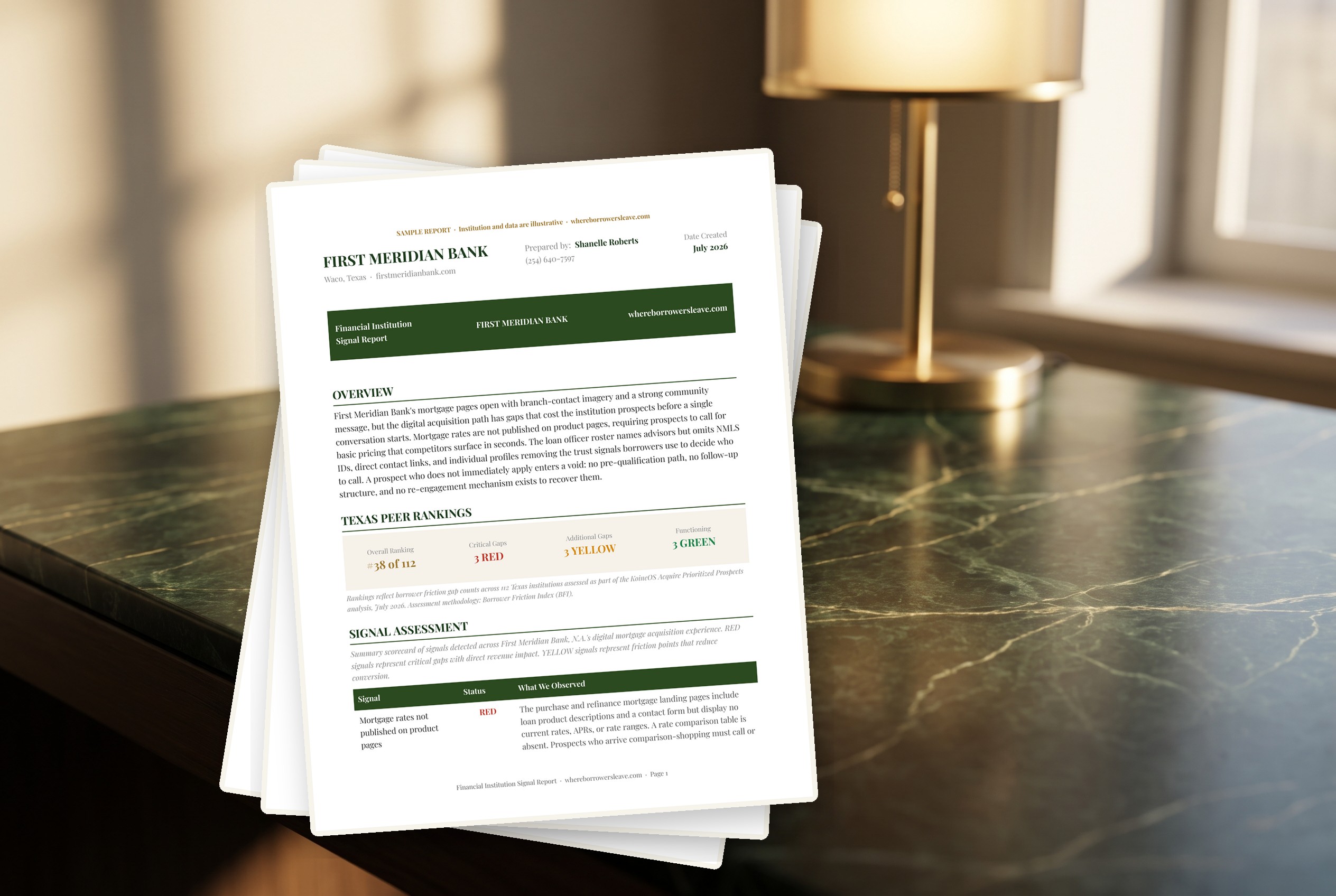
See a real Mortgage Signal Report. No email required.
First Meridian Bank, N.A. is a real Texas bank. The name and identifying details are changed; nothing else is. The findings, the statuses, and the peer ranking are from our research across 112 Texas institutions, built with the same Borrower Friction Index methodology behind every report we deliver. Download it and see the scorecard, the findings, and the format before you commit a dollar.
PDF · Real Texas institution, identifying details changed
Every Mortgage Signal Report runs on the Borrower Friction Index.
The BFI is the proprietary diagnostic built for evaluating a lender's digital mortgage presence from publicly observable signals alone. If it's visible from the outside, it's part of the experience you're delivering, whether or not anyone inside your institution has looked at it that way.
Every signal in the report is rated against one of four statuses, so a page full of findings reads in seconds, not paragraphs.
Seven of the 45 signals we check.
Is your mortgage product reachable through a fully digital application path, without a phone call or branch visit? A borrower who's ready and can't apply online applies somewhere else. If the path doesn't exist at all, this signal reads grey instead of red, and that absence is its own finding.
Is your SSL certificate valid and correctly issued? A mismatched certificate throws a browser warning that stops a borrower cold, or lets financial data cross a compromised connection. Either outcome is a funded loan lost.
Does your site age and design currency match how actively you're investing in the mortgage channel? Copyright year, last update, crawl history: a visitor reads all of it, whether you intend them to or not.
Is your FDIC or NCUA certificate number visible next to your deposit-insurance badge? A badge with no number is unverifiable, and it's the same visual element a fraudulent site would display. One line of copy closes the gap.
Are your loan officers named, with direct contact information? A local lender's advantage over a fintech is a human being who knows the market. An anonymous contact form erases that advantage before the borrower has a reason to value it.
Do your mortgage posts use product-specific calls to action like "Check today's rate" instead of a generic "Apply now"? When there's no mortgage-specific social content to evaluate at all, the signal reads grey, and the absence is the finding. When it exists but defaults to a generic "Apply now," it moves to yellow: present, doing its job poorly.
Is your published mortgage rate current and dated? A rate page that's accurate and clearly timestamped removes the single biggest reason a borrower calls a competitor to compare. When we find this working, the report says so, by name, not just by omission.
Get the full index, free.
All 45 signals across website friction, fraud indicators, compliance gaps, and social media, with severity ratings for each. Run it yourself against your own mortgage page, or let us run it for you.
Sent to your inbox. We never sell your information.
A diagnostic is only as credible as the person who built it and how much of it they're willing to show you before you pay.
The Borrower Friction Index was built by someone with twenty years in design and technology systems and two and a half years inside institutional banking, not by a marketing agency guessing at what a lending executive cares about. That combination is why the signals map to funded volume and pull-through instead of vanity metrics like traffic and impressions.
The second reason is simpler. All 45 signals are published above, free, before you've spent a dollar. Most vendors sell the framework. This one gives it away and sells the labor of applying it correctly to your specific institution. If the methodology only held up behind a paywall, that would be worth noticing. It doesn't need one.
Not a vendor pitch.
Most digital reports arrive after a sales call. This one arrives before. Most assessments are built from survey data, industry benchmarks, or self-reported answers. This one is built from what any borrower with a browser can see on your mortgage page today. Most reports sell a service. This one sells the conversation.
The lenders who find this credible are the ones who already suspect something. The Head of Mortgage who's watched pull-through hold flat while inquiry volume climbs. The CLO who's seen application starts drop with no explanation from the core system. The VP of Retail Lending who's flagged the rate transparency gap internally without the authority to move it up the list.
This report doesn't tell you something you don't already suspect. It tells you what it looks like from the outside, and gives you something to put in front of the people who can act on it.
One report. One price. One action.
Mortgage Signal Report
Run personally by the researcher who built the Borrower Friction Index, from Waco, Texas. No offshore analysts, and no non-citizen ever touches the work. Every finding carries the name of the person who stands behind it.
- All 45 BFI signals, run against your mortgage product specifically: product page, application path, rate page, fraud indicators, mortgage-specific social content. The framework is published free above, and your team still couldn't replicate this report with it in hand. The credibility isn't in keeping the signals secret. It's in what they track: an index designed by someone who understands systems and borrower acquisition, and the judgment to apply it correctly to your institution.
- Every finding names the exact page it sits on, so your team can verify each one in minutes without taking our word for anything. Outside-in isn't a limitation. It's the only view your borrower ever gets, and the view no core banking report can show you.
- Written about the system, not the team. Nothing in it says anyone failed. It names what the technology in front of your people is doing to their pipeline, in the red, yellow, green, grey format a board reads in seconds. Built to be put in front of the people who control budget, not filed.
- If your mortgage presence comes back mostly green, the report says so, by name. Independent confirmation that your channel is sound is worth walking into a board meeting with. You're paying for the answer, not a problem list.
Two guarantees, in writing
On time: 3 business days from request or the full $1,000 back.
On substance: if the report doesn't surface gaps specific enough for your team to act on, say so in your reply and I'll refund it. You keep the report either way.
Your report is private. It's delivered to you, never publicly published, never used in our marketing without your consent, and never shared without your consent.
And when it's delivered, we're done, unless you say otherwise. The last page holds one optional next step: a single conversation, only if you ask for it. No call before, no call after, no service menu. The report has to be worth $1,000 standing alone, because for most buyers it's the only thing we'll ever sell them.
Buy the Mortgage Signal Report →Why $1,000: running this internally means hiring a UX researcher and a compliance-adjacent fraud reviewer before you've decided whether the gap is worth closing. The report answers that question first, at the price of finding out.
Shanelle Roberts

Shanelle Roberts is a customer acquisition researcher and systems designer based in Waco, Texas. Twenty years in product and systems design across T-Mobile, Wilmington Trust, M&T Bank, Microsoft, Expedia, and the UN World Food Programme, including two and a half years inside a regional bank where she led the design team that built the first secure digital payment experience for an institution where fraud had cost mid eight figures across three prior years.
She holds a U.S. Utility Patent from T-Mobile and designed the iOS version of Scam Shield, which stopped over two billion robocalls in its first eighteen months.
That combination, design and technology systems experience paired with time spent inside a regional bank's own fraud and payments problem, is what the Borrower Friction Index is built on. It reads a lending institution's public presence the way a systems designer would, not the way a marketing consultant would.
The Borrower Friction Index is the methodology behind the Mortgage Signal Report: public digital footprint analysis, no internal access required, run the same way every time so findings are comparable across institutions.
Smart Chic Systems, Inc. is based in Waco, Texas. Every engagement is delivered in the United States by American citizens. No offshore analysts.
See what your mortgage page is telling borrowers before you spend a dollar fixing it.
Buy the Mortgage Signal Report, $1,000 →Delivered in 3 business days, or your money back.